De Blasio’s Housing Legacy In 9 Graphics
Samuel Stein
New York City is facing a combined set of crises relating to the Covid-19 pandemic and the recession that resulted from it. At the same time, in just six months, the city will begin voting for the next mayor who will undoubtedly face a complex set of challenges relating to housing, among many other factors of urban life. In this context, we are looking back at the previous seven years of housing policy accomplishments and shortcomings under Mayor de Blasio to better understand the situation we face today and the possible ways forward.
Here, we highlight some of the key findings from the report to sketch out a picture of the de Blasio housing legacy. For a full look at our findings, read our report Assessing de Blasio’s Housing Legacy: Why Hasn’t the “Most Ambitious Affordable Housing Program” Produced a More Affordable City?, produced in collaboration with Association for Neighborhood Housing and Development, Center for New York City Neighborhoods, Make the Road New York, Mutual Housing Association of New York, and VOCAL-NY.
1. Housing affordability was already a major crisis when the pandemic and recesssion hit.
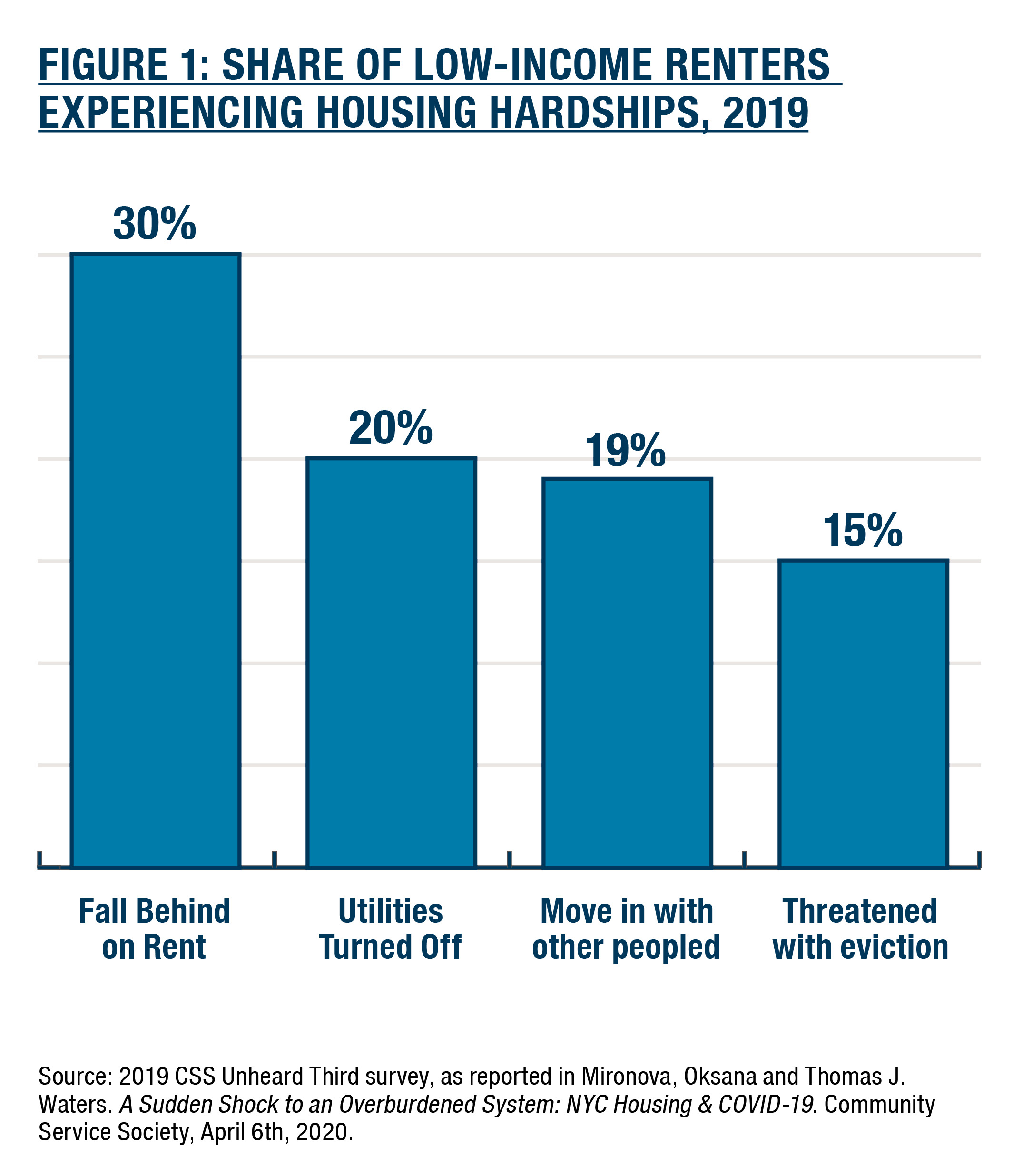
In 2019, four in ten low-income New Yorkers were either homeless or severely rent burdened, paying more than half of their income in rent. Thirty percent of low-income renters fell behind on their rent, 20 percent faced utility shut-offs, 19 percent had to move in with others, and 15 percent faced threats of eviction.[1] Working-class and poor New Yorkers continue to experience serious housing hardships, with the most acute conditions disproportionately facing Black, Latinx, and Asian tenants. The Covid-19 pandemic and its economic impacts threw these facts into stark relief.
2. As promised in his campaigns, the de Blasio administration achieved record levels of affordable housing investment and production.
As of July 1, 2020, the administration achieved the following breakdown of affordable housing construction and preservation by AMI levels:
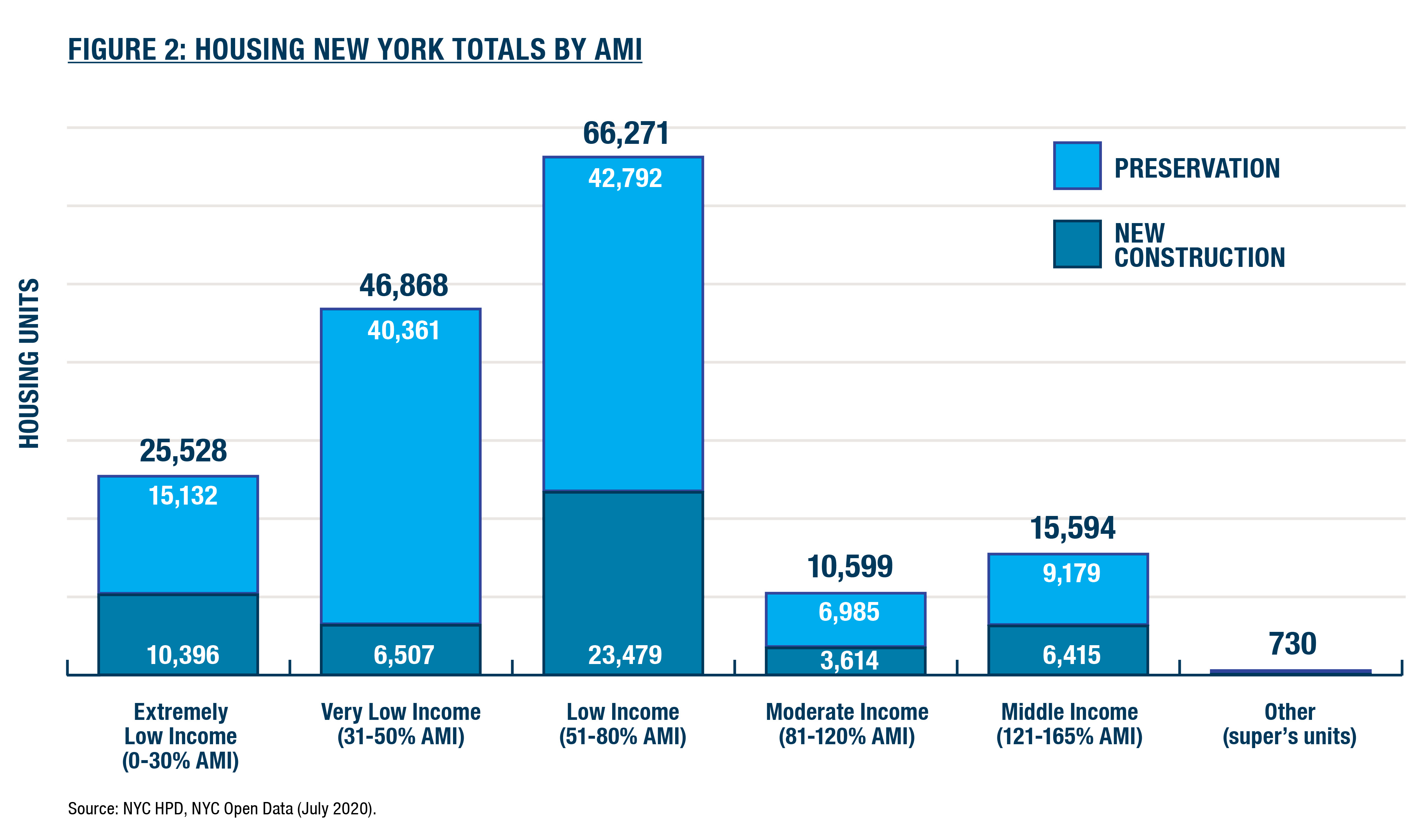
Within these unit counts and AMI groupings, the administration reports that they have produced 12,941 units for homeless New Yorkers (8 percent of total) and 9,180 units for seniors (6 percent of total).[2] Roughly half of these are preservation rather than construction units, however, and thus are largely occupied. This provides fewer immediate opportunities for homeless or senior households to find relief. Between Fiscal Years 2015 and 2019, only 2,618 homeless households were placed in Housing Preservation and Development (HPD)-financed units.[3]
3. The mayor’s primary housing plan, however, was not designed to meet the needs of those with the most severe rent burdens.
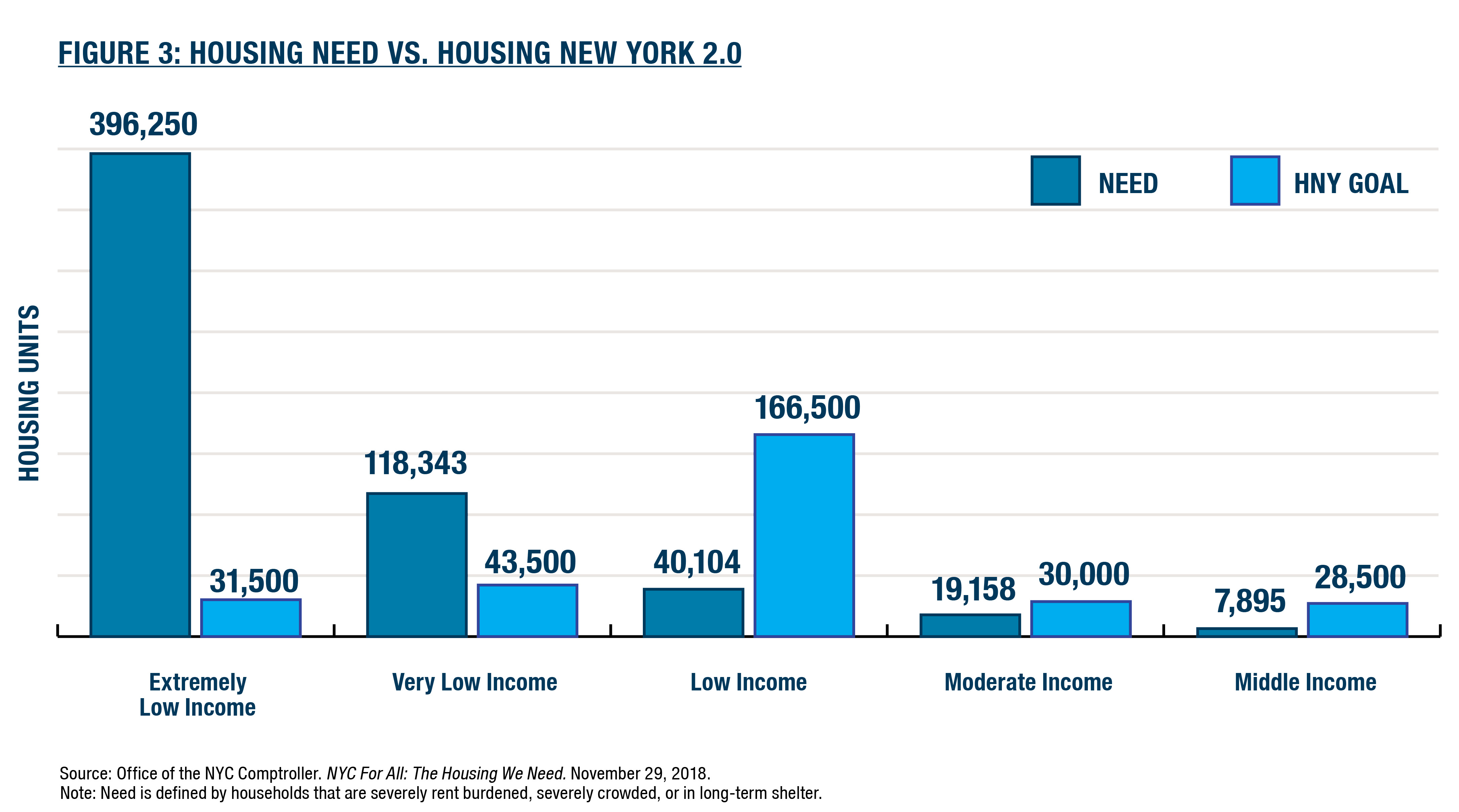
The mayor’s housing plan, Housing New York, paints an imperfect portrait of the city’s demographics and housing demands. According to a 2019 analysis by the Association for Neighborhood and Housing Development, “Housing New York is developing at deep levels of affordability, but not deep enough for New York’s needs.”[4] This dynamic can be demonstrated by assessing who suffers the greatest distress in the current housing market compared to whom is prioritized in Housing New York. A January 2020 analysis by office of the City Council Speaker pointed out that the plan’s income targets did not at all match the populations with the severest rent burdens—those paying a majority of their incomes in rent.[5] By that metric, the plan meets less than 15 percent of the need for those most vulnerable to becoming homeless—severely rent-burdened extremely low- and very low-income New Yorkers—while overproducing for moderate- and middle-income New Yorkers.[6]
4. The geography of affordable housing production has failed to challenge the city’s spatial dynamics of gentrification and segregation.
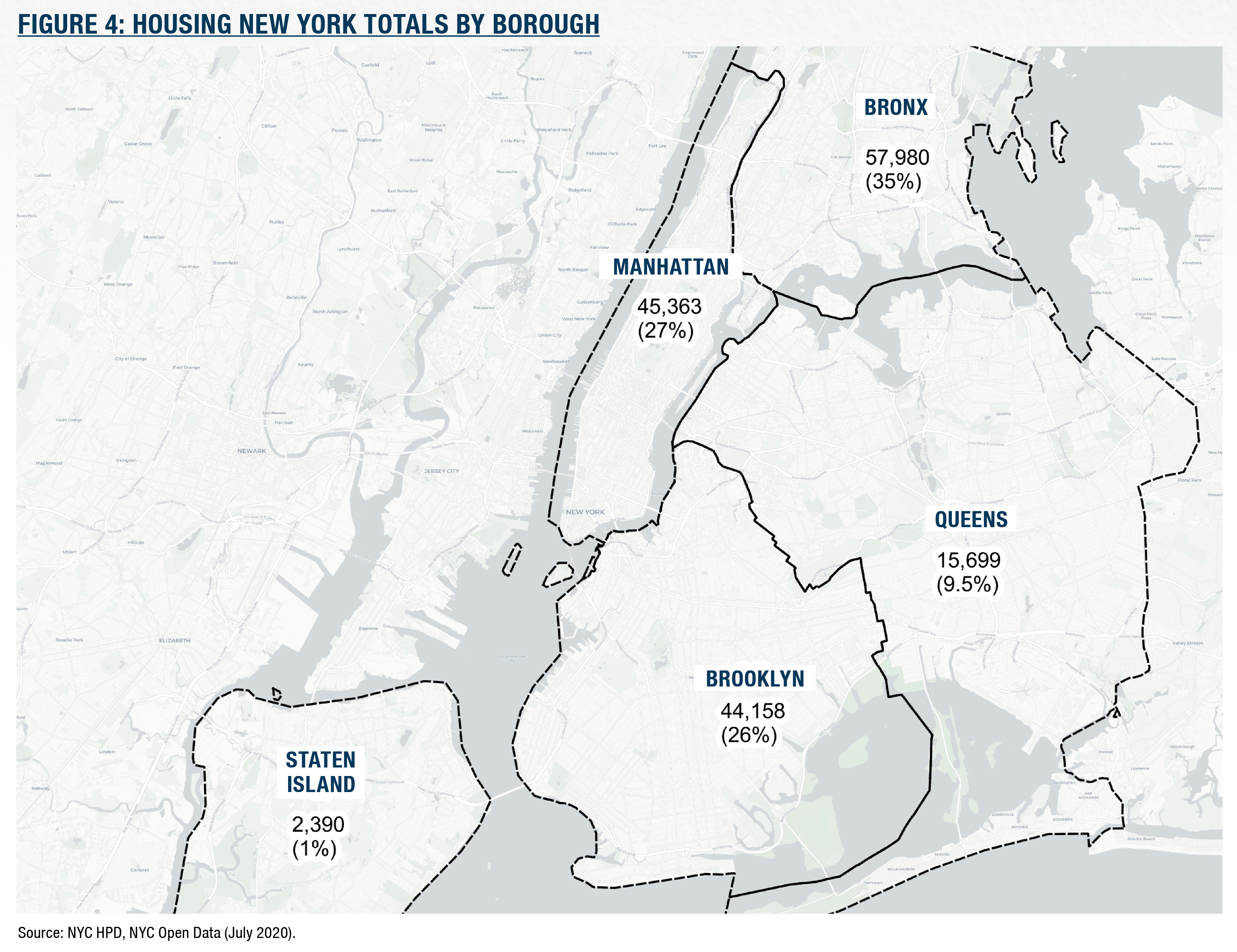
The units developed in Housing New York were predominantly located in the Bronx and Brooklyn, with some in Manhattan. Relatively few units have been produced in Queens and Staten Island, the boroughs with the smallest amounts of subsidized, public and regulated housing in the city, and with the largest pockets of low-density, high income and largely white neighborhoods. The de Blasio plan therefore does little to challenge the long-standing dynamics of racial segregation, concentrations of affluence, political inequality, and uneven development in the city.[7] High-income housing continues to be built in low-income neighborhoods, including, in some cases, “affordable housing” that is designated for people making much more than the neighborhood average. The opposite dynamic—the true test of integration, and the opposite of gentrification—remains relatively rare. Though the city studied this dynamic and, in 2020, released its Where We Live report, little has been done over the mayor’s seven years in office to actually change it.[8]
5. Rent burdens for low-income New Yorkers have remained punishingly high.
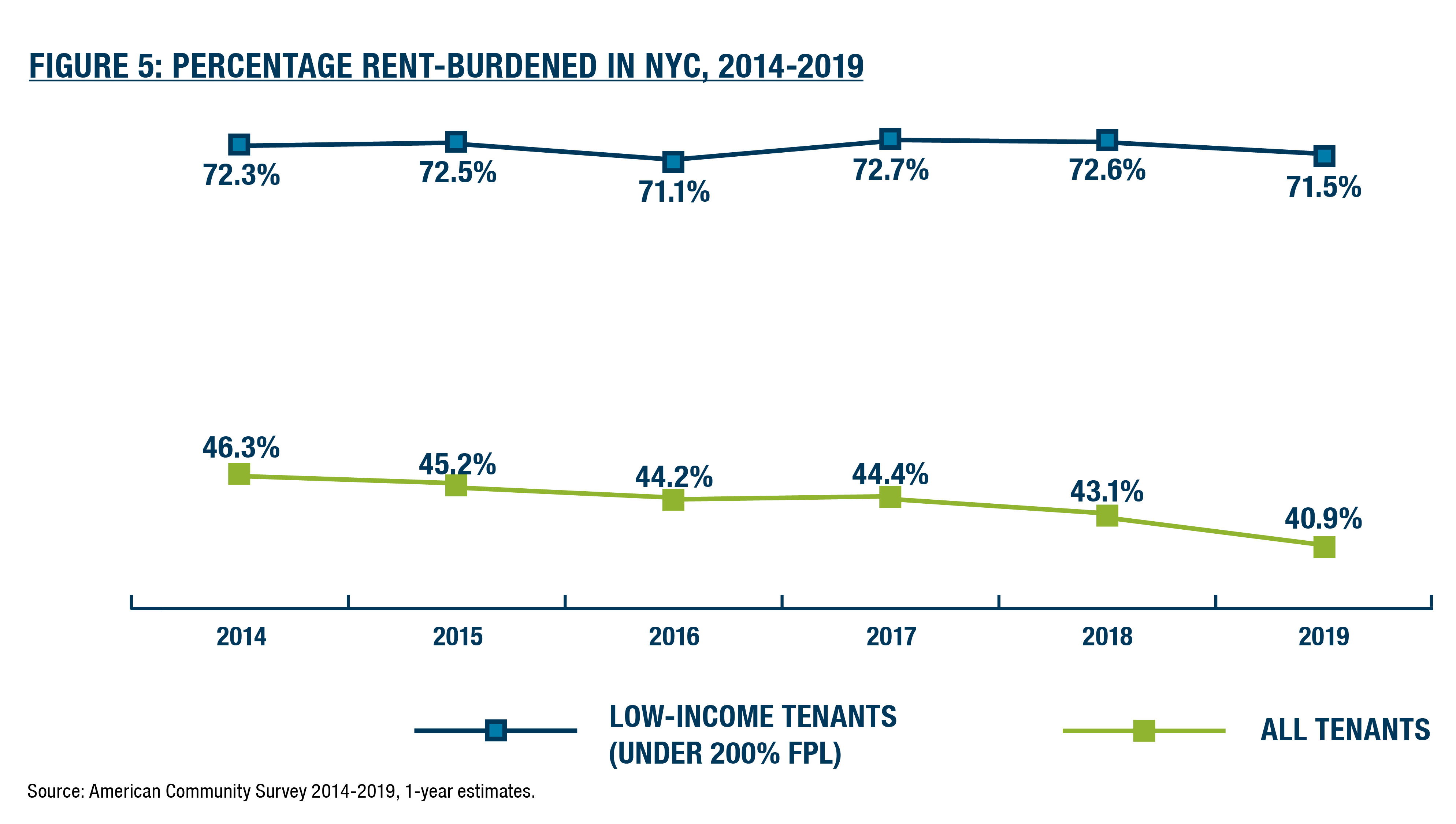
During the Bloomberg administration, the city crossed a dangerous precipice: between 2008 and 2011, housing prices became unaffordable to a majority of New York renters (as measured by the standard formula of one’s ability to pay under 30 percent of their income in rent). According to the 2017 Housing and Vacancy Survey, the most comprehensive survey of local housing dynamics, housing unaffordability did not abate under de Blasio.[9] The American Community Survey suggests a somewhat lower overall rent burden, but also highlights a crucial dynamic: while the percent of all tenants with rent burdens appeared to decrease, from 46 percent in 2014 to 41 percent in 2019 (approximately the same rate as 2008), the percent of low-income tenants (those under 200 percent of the Federal Poverty Line) with rent burdens remained much higher at 72 percent over the course of the de Blasio administration. In fact, during this time the percentage of low-income New Yorkers paying more than half of their income in rent rose by one percentage point.
6. De Blasio’s Rent Guidelines Board approved three rent freezes for rent stabilized tenants, and when it did permit increases they were notably lower than those of previous administrations.
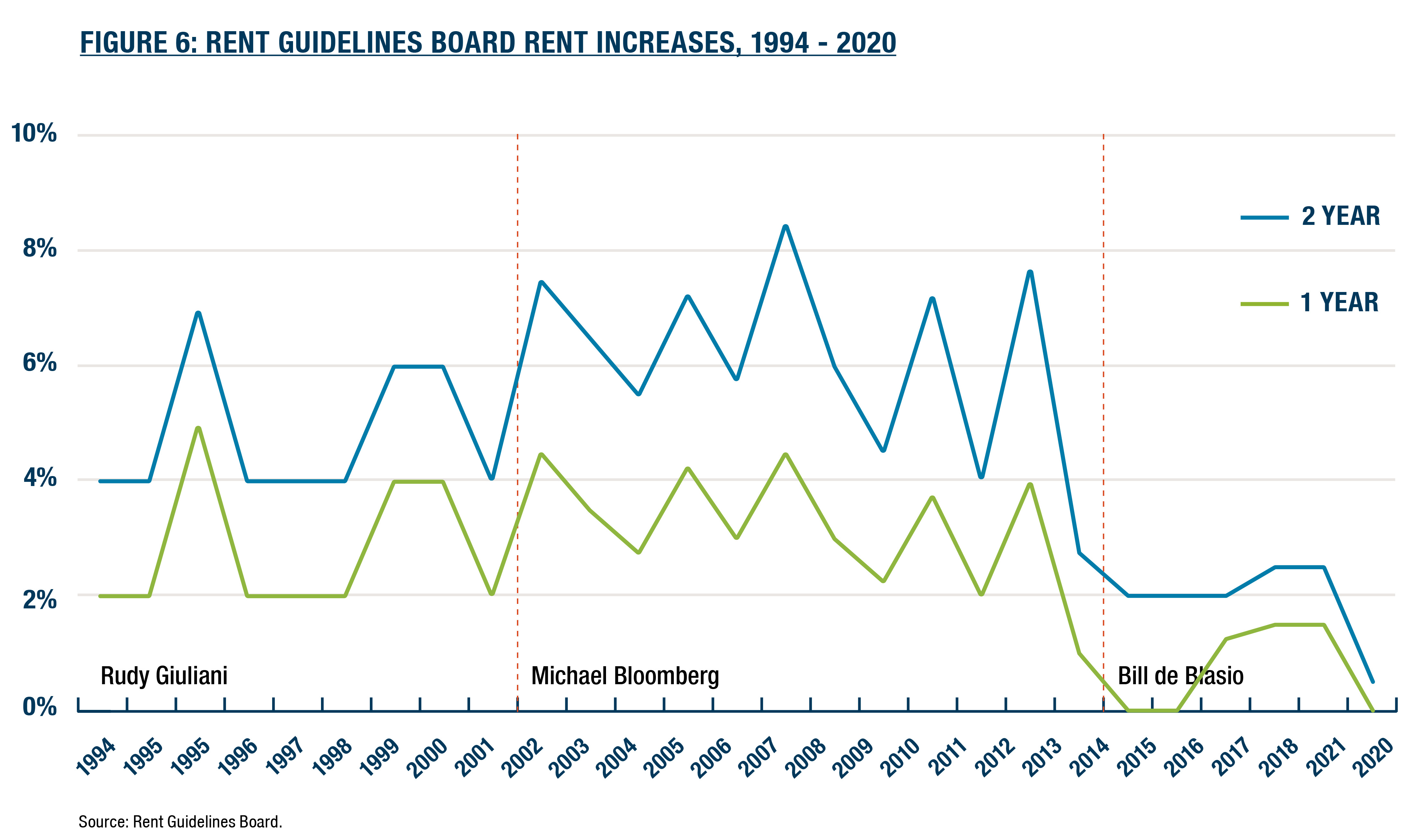
With de Blasio’s appointees in place, the Rent Guidelines Board provided a fairer look at the annual data and voted for 1-year rent freezes for three years, and lower than average increases in the others. This shift follows tenant movement advocacy to reform not only the makeup of the board, but the most important metrics it uses in making its annual determination.
7. City-sponsored neighborhood upzonings have, until very recently, exclusively targeted areas of the city with high concentrations of working-class people of color.
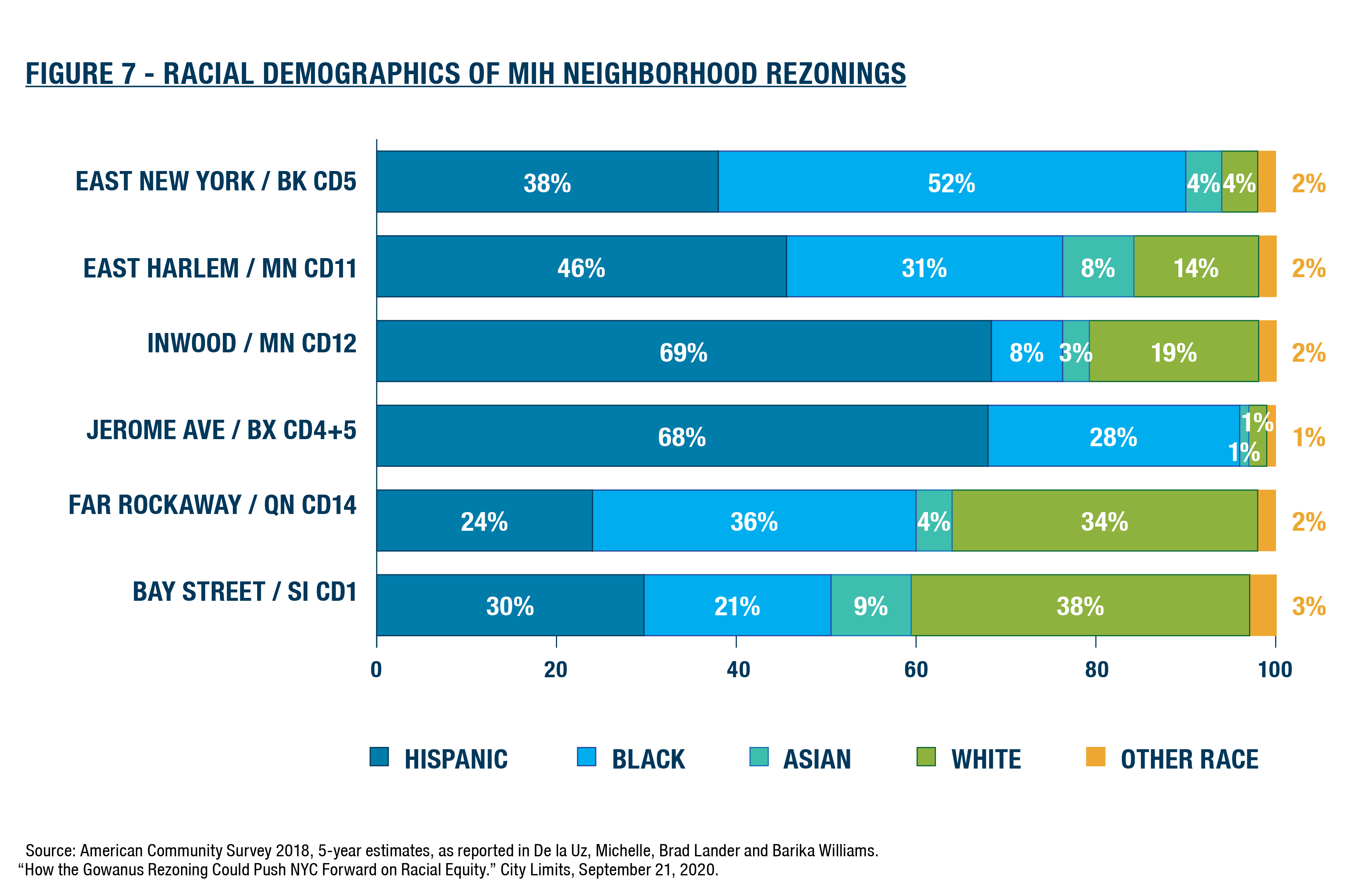
One of de Blasio’s signature housing policies was Mandatory Inclusionary Housing (MIH), which updates the city’s zoning code to require that when the city increases the development capacity of a particular area (or “upzones” it), developers must set aside some of the apartments in new buildings for households making certain incomes. The administration hoped to complete 15 city-sponsored neighborhood-scale MIH rezonings. In case after case, the de Blasio administration selected areas of the city that were generally working class, largely Black, Latinx, or Asian, and often surrounded by existing affordable housing. In fact, in most of these areas, most of the recent housing production had been subsidized and affordable. By changing the zoning code to allow for housing that was unaffordable to most neighborhood residents—including even the portion of new buildings set aside as “affordable housing”—the administration earned deep animosity and created the conditions to undermine its own stated goals of combating gentrification and producing a more affordable city.
8. A vast majority of the time, developer-initiated MIH rezonings also failed to produce housing that was affordable to average local residents.
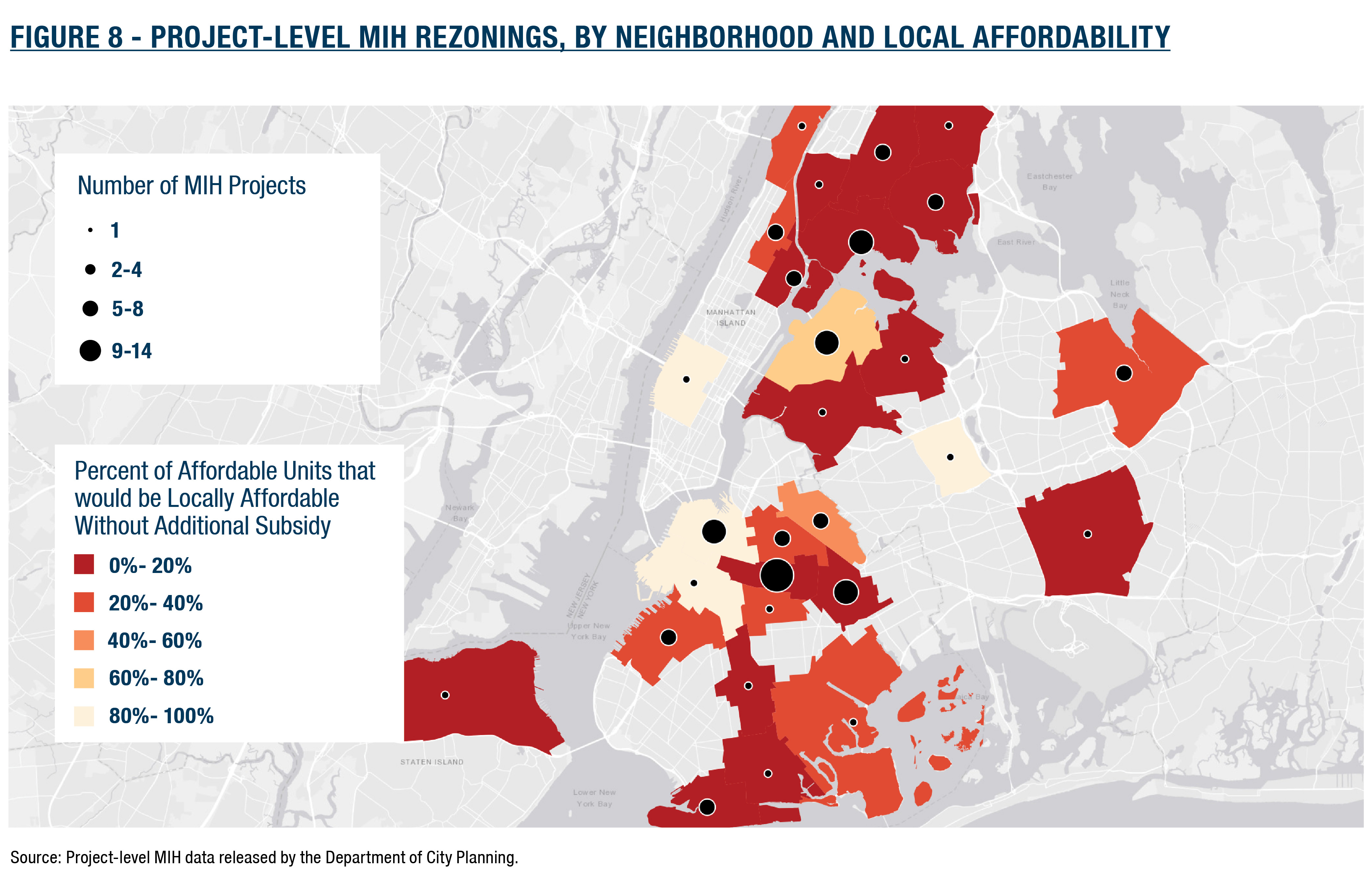
The city has rezoned specific blocks for MIH developments 70 times in 28 neighborhoods across the city.[10] Unless other subsidies were offered on top of MIH, in half of these projects both the market-rate housing and the affordable housing was targeted toward people making more than the neighborhood’s average income. Not a single one of the 9,902 apartments built in 21 MIH projects in neighborhoods with average incomes under 40% of AMI would be affordable to the typical local resident—let alone anyone making less than the neighborhood average—without an additional subsidy. In only 23 percent of projects were a majority of “affordable” units affordable to average local residents. In total, 89 percent of apartments approved through project-specific MIH rezonings would be unaffordable to the average neighborhood resident without additional subsidies. Even among those projects’ “affordable” units, 75 percent were targeted toward people making more than the neighborhood average.[11]
9. Living conditions have deteriorated in public housing, even while conditions have improved overall in private housing.
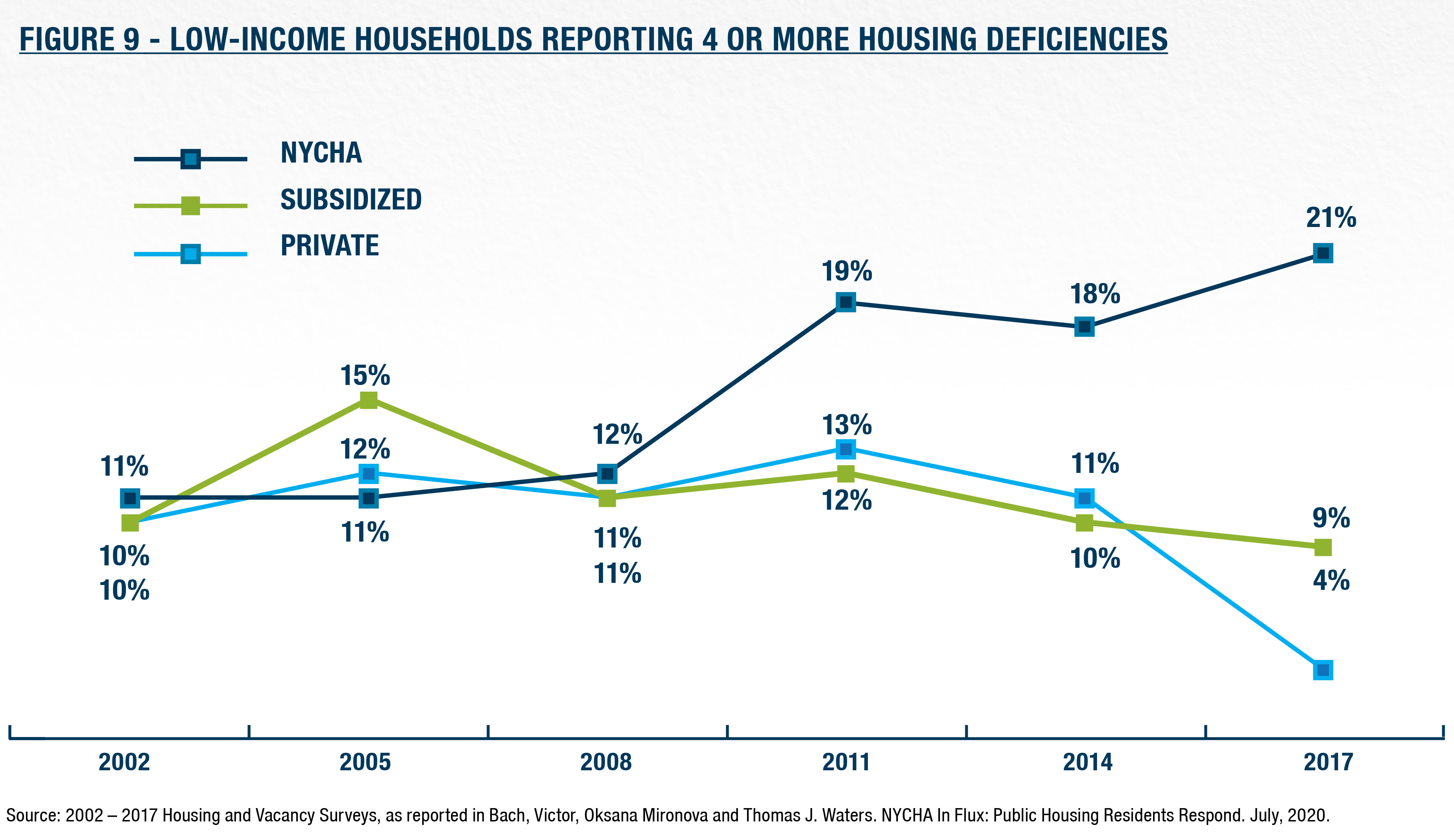
In 2001, the percentage of low-income households reporting four or more deficiencies was largely the same across public, subsidized, and private housing at 11 percent to 12 percent. By 2011, the percentage of public housing residents living in this condition shot up by 7 percent, while those in other housing types rose only 1 percent. During the first three years of the de Blasio administration, the percentage of low-income private housing tenants living in these conditions dropped laudably from 11 percent to 4 percent. The percentage in subsidized housing dropped by 1 percent. The percentage from public housing, however, continued to rise from 18 percent to 21 percent, or more than one in five public housing households.[12]
1. Mironova, Oksana and Thomas J. Waters. A Sudden Shock to an Overburdened System: NYC Housing & COVID-19. Community Service Society, April 6, 2020.
2. Data retrieved from HPD via the NYC Open Data Portal.
3. Data provided to Coalition for the Homeless by HPD, via FOIL.
4. Sosa-Kalter, Stephanie. Maximizing the Public Value of New York City-Financed Affordable Housing. Association for Neighborhood Housing & Development. October 10, 2019.
5. Johnson, Corey. Our Homelessness Crisis: The Case for Change. Office of the Speaker of the New York City Council. January 30, 2020.
6. Stringer, Scott. NYC For All: The Housing We Need. Office of the New York City Comptroller. November 29, 2018.
7. Angotti, Thomas, and Sylvia Morse, eds. Zoned Out!: Race, Displacement, and City Planning in New York City. Urban Research (UR), 2017.
8. Where We Live NYC: Fair Housing Together. The City of New York, November 2020.
9. 2017 New York City Housing and Vacancy Survey.
10. 73 projects were identified, but unit counts were not available for three projects and so were illuminated from this analysis.
11. Based on an analysis by MHANNY of project-level MIH data released by the Department of City Planning.
12. This trend is also visible in public housing tenants facing 3 or more deficiencies, a percentage that rose from 35% to 37% during the same time period. Bach, Victor, Oksana Mironova, and Tom Waters. NYCHA In Flux: Public Housing Residents Respond. Community Service Society. July, 2020.